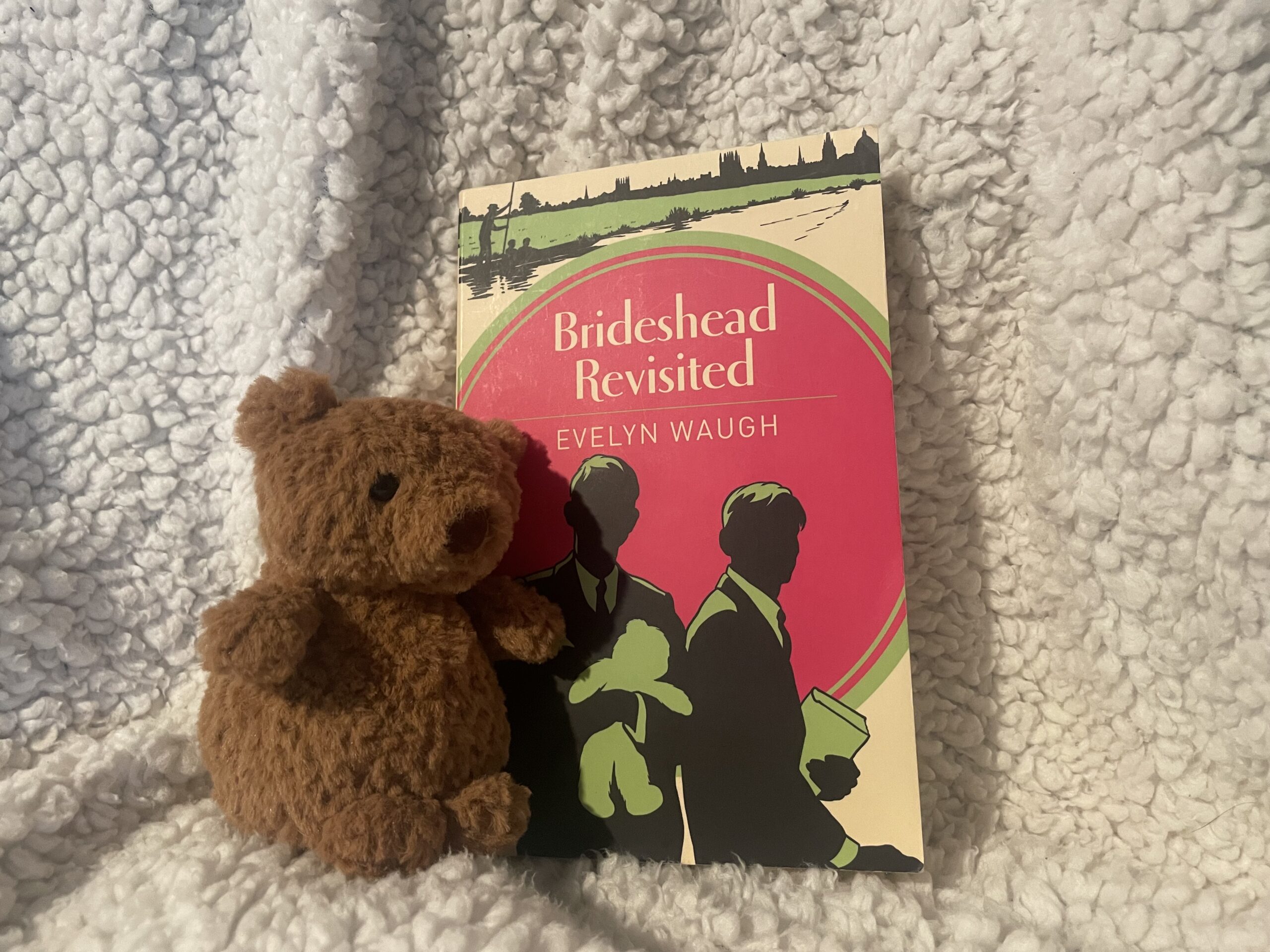
Brideshead Revisited by Evelyn Waugh
I put off writing this review for a while because I just have so many thoughts about the plot. The first was that, very early on, I had the thought that this maybe inspired the movie Saltburn (which I, admittedly, haven’t seen). Some Googling and asking around told me that yes, possibly, maybe it did. It’s very different from what I know of that movie – much less horror and thriller and more introspective family study – but the fundamental idea of a loner of a lower class background getting swept up into the glamour of old money at their too-big estate house? Yeah, that tracks.
In a lot of ways, it’s a book that’s very of its time – there’s a few time jumps, Charles randomly acquires a wife near the end who remains nameless for like five pages, most of the characters associated with queerness end up being punished. But I found there was still a lot of value in the story, and the way that it explored family, religion, and class in 1920s and 30s Britain.
It’s also a book where you have to take the time into consideration when you analyse the events themselves. For example, the nature of Charles and Sebastian’s relationship remains somewhat ambiguous, but that’s because the book was written in the 40s. It’s very clear, especially from comments made later to Sebastian’s sister Julia, that they were lovers when they were friends in the 20s. He compares the siblings, and in many ways is clear that he’s using Julia as a replacement for a relationship with Sebastian that’s become lost to him.
By the end of the book, Sebastian has a tragic fate and Charles is left alone and divorced in the Army returning to Brideshead house to train. In the two of them, queerness is punished or a phase that someone grows out of or learns to forget. What I found interesting was the existence of a third character, Anthony, who is much more openly referred to as being gay and living with men throughout his life and who, the last we see of him, appears to be living his life quite happily. To me, that makes shame and secrecy bigger pitfalls in the book than queerness. Anthony, who always lived his life openly, continues to live his life as it was. He may be annoying to many around him, but he’s alive and (presumably) in love. Charles and Sebastian, who were entangled in the Marchmain family secrets and Catholic guilt, both can’t cope with the reality of what they want.
“Sometimes I feel the past and the future pressing so hard on either side that there’s no room for the present at all.”